Choosing a Side Loader Crane in 2026 requires more than comparing lifting capacity and price. The right model must match your container sizes, truck chassis, delivery routes, and daily loading rhythm. In field evaluations, small differences matter. A crane reaching 6.5 metres may work beside a warehouse, yet struggle on uneven ground or narrow streets. Operators also notice control smoothness, setup time, visibility, and hydraulic heat after repeated cycles. Numbers help. They do not tell everything.
This guide examines rated capacity, outreach, mounting compatibility, stabilizer design, remote controls, maintenance access, and supplier support. It also considers emissions requirements, digital monitoring, spare-part availability, and training records. A 2026 purchase should be checked against the truck’s gross vehicle weight, axle limits, and intended payload. Ask for load charts, test documentation, warranty terms, and references from comparable fleets. Treat impressive brochures carefully. Real operating evidence is stronger.
The best choice is not always the largest crane. An oversized unit can reduce payload and increase installation demands. An undersized unit may create unsafe habits, delays, and costly rehandling. I have seen projects focus heavily on reach while overlooking ground clearance and service access. That mistake is easy to repeat. Honest assessment matters. Compare several working scenarios, including windy sites, night deliveries, and emergency maintenance. Then select the Side Loader Crane that provides dependable performance, controlled risk, and practical value throughout its service life. No selection is perfect. Good decisions leave room for revision.
How to Choose a Side Loader Crane in 2026?
Define Your Side Loader Crane Application and Lifting Requirements
Start with the worksite, not the crane catalogue. A side loader crane for urban delivery faces narrow streets, parked vehicles, and uneven loading areas. A construction application may require longer outreach, repeated lifts, and larger safety margins. Record the heaviest load, its dimensions, centre of gravity, lifting frequency, and average working radius. Small measurement errors can become expensive.
Use the actual load chart, not the maximum headline capacity. The U.S. Bureau of Labor Statistics recorded 1,069 fatal work injuries in transportation and material moving occupations during 2023. This broad category is not specific to side loader cranes, but it reinforces the need for disciplined load planning. Compare rated capacity at each radius, not only at the nearest-point position. Check residual vehicle payload after mounting the crane, hydraulic equipment, operators, and tools.
Think about the complete lifting cycle. Will the crane load pallets from ground level, reach over a side rail, or place materials behind the vehicle? Confirm mounting space, stabiliser deployment, PTO demand, hydraulic flow, and terrain conditions. Standards such as EN 12999 emphasise stability, control systems, and safe operating limits. Field experience still matters. A compact design may fit the route better, yet reduce useful reach. That trade-off is easy to miss. Recheck the assumptions with real load samples before purchasing.

The chart compares typical planning ranges for common side loader crane applications. Use the required lifting capacity and working radius as the first screening criteria, then confirm mounting space, vehicle stability, hydraulic flow, operating frequency, and applicable safety regulations.
Values shown are representative engineering planning benchmarks for preliminary selection only. Final crane specifications must be verified against the actual load center, lifting geometry, vehicle chassis, ground conditions, and local regulations.
How to Choose a Side Loader Crane in 2026?
Choosing a side loader crane starts with the load path, not the brochure. Fortune Business Insights valued the global crane market at about USD 36 billion in 2023. That broad figure hides major application differences. Side loaders suit repetitive pallet handling beside roads. Knuckle-boom cranes provide reach and compact folding. Telescopic cranes offer straighter lifting, but need more clearance. The best choice follows payload, outreach, cycle frequency, and unloading space.
Mounting changes stability and daily productivity. A chassis-mounted crane preserves trailer length, while a rear-mounted unit can improve access near the cab. A fixed deck supports simple loading patterns. A sliding deck offers better positioning when the truck must stand away from the curb. Keep the heaviest loads near the crane’s rated working zone. Never judge capacity only by maximum tonnage. ISO 4301-1 evaluates crane duty through load spectrum and operating cycles, which better reflects real wear.
Loading configuration matters most on uneven sites. Side access works well for pallets, steel bundles, and roadside deliveries. Rear access may suit narrow yards, but it can create longer repositioning cycles. I would leave a practical capacity margin, often around 10 percent, after checking the load chart and ground conditions. That margin is not universal. It must be verified by a qualified engineer. A common mistake is selecting reach before checking axle loads. Fit matters more. Recheck turning radius, outrigger width, remote-control visibility, and service access before purchase.
| Comparison Area | Knuckle-Boom Crane | Telescopic-Boom Crane | Compact Folding Crane | Practical Selection Guidance |
|---|---|---|---|---|
| Typical operating principle | Hydraulic articulated boom folds at one or more joints and can work close to the vehicle. | Hydraulic sections extend and retract in a straight line to reach farther from the mounting position. | Short, lightweight articulated boom designed for lighter loads and limited installation space. | Select the boom architecture according to reach, lifting height, payload, and available chassis space. |
| Representative lifting moment | Approximately 10–80 tonne-metres for common truck-mounted applications. | Approximately 8–60 tonne-metres for common truck-mounted applications. | Approximately 3–20 tonne-metres for compact or light-duty applications. | Use the manufacturer’s rated load chart; lifting moment alone does not determine the safe load at every radius. |
| Typical working reach | About 4–20 m, depending on boom sections and configuration. | About 5–25 m, depending on the number and length of telescopic sections. | About 3–12 m, generally prioritising compactness over maximum reach. | Compare the required load radius with the crane’s load chart rather than comparing maximum reach only. |
| Strengths | Good positioning accuracy, efficient stowage, and strong versatility for pallets, machinery, pipes, and containers. | Long horizontal or vertical reach, straightforward boom geometry, and suitability for reaching over obstacles. | Lower vehicle weight, smaller installation footprint, and easier suitability for urban or light-duty vehicles. | Choose knuckle-boom for versatility, telescopic-boom for reach, or compact folding equipment for payload-sensitive vehicles. |
| Trade-offs | More joints and hydraulic components require careful maintenance and correct folding clearance. | Longer retracted length and greater rear or side overhang may affect vehicle layout and manoeuvrability. | Lower capacity and shorter reach limit the size and distance of loads that can be handled safely. | Check service access, transport dimensions, axle loads, and the crane’s stowed position before purchase. |
| Best suited load types | Palletised goods, construction materials, steel products, equipment, pipes, and general cargo. | Long materials, elevated placement, loads behind obstacles, and applications requiring extended reach. | Light pallets, maintenance equipment, landscaping materials, and small construction loads. | Match the crane to the most frequent load type, not only the maximum occasional load. |
| Control options | Manual valve banks, radio remote controls, proportional controls, and electronic load-management systems. | Manual or remote hydraulic controls with proportional extension and boom-position control. | Typically simple hydraulic controls; proportional or remote control may be available on higher-specification units. | Remote proportional control can improve placement accuracy, but it adds cost and requires operator training. |
| Mounting Option | Installation Position | Main Advantages | Key Limitations | Recommended Application |
|---|---|---|---|---|
| Behind-cab frame mount | Mounted on a reinforced subframe directly behind the cab. | Good visibility during loading, centralised weight distribution, and convenient access to the cargo area. | May reduce usable body length and can interfere with cab tilt, body equipment, or front axle loading. | Suitable when frequent forward-side loading and good operator visibility are priorities. |
| Rear-frame mount | Installed at or near the rear of the truck body or chassis. | Preserves front cargo space and can provide useful reach behind or beside the vehicle. | Can increase rear axle loading, rear overhang, and tail-swing requirements. | Useful for rear delivery, long bodies, and applications where the front cargo area must remain open. |
| Central body mount | Installed between the front and rear sections of the load body. | Can provide balanced access to both sides and a relatively central lifting position. | Requires careful body design and may divide the usable loading area. | Appropriate for specialised bodies or operations needing access along both sides of the vehicle. |
| Removable or detachable subframe | Crane is fixed to a designed subframe that can be removed or exchanged with the body. | Improves fleet flexibility and allows one chassis to support different equipment layouts. | Higher engineering complexity, added connection points, and stricter inspection requirements. | Best for multi-purpose fleets and seasonal or interchangeable body systems. |
| Side-offset mount | Positioned toward one side of the chassis to maximise access on the opposite side. | Creates a clear loading zone and can support efficient curbside or roadside operations. | Asymmetric loading can affect stability, and outrigger placement must be planned carefully. | Suitable for repetitive loading from a fixed side, subject to stability and local traffic requirements. |
| Loading Configuration | Typical Equipment | Operating Characteristics | Important Design Checks | Best-Fit Use Case |
|---|---|---|---|---|
| Curbside loading | Side-mounted crane, hydraulic outriggers, pallet forks, hook, or lifting beam. | Loads are picked up and placed from the roadside without requiring a separate loading dock. | Check traffic clearance, working-zone protection, outrigger deployment, and off-level ground conditions. | Urban delivery, construction supply, utility work, and roadside service operations. |
| Two-sided loading | Central or offset crane with stabilisers designed for left- and right-side operation. | Allows loading from either side and improves route flexibility where access conditions change. | Verify stability on both sides, hydraulic hose routing, operator sight lines, and asymmetric load effects. | Multi-stop delivery routes and worksites with variable access directions. |
| Rear loading | Rear-mounted boom with hook, lifting beam, forks, or specialised attachment. | Loads are handled behind the vehicle, often with greater reach along the rear axis. | Assess rear overhang, tail-swing, rear axle capacity, body-door clearance, and reversing visibility. | Long loads, rear-access sites, and vehicles with a dedicated rear loading zone. |
| Pallet and fork handling | Fork attachment, pallet hook, or adjustable lifting frame. | Enables direct placement of palletised materials without a forklift at the destination. | Confirm fork capacity, pallet dimensions, load centre, fork spacing, and rated capacity at the required radius. | Building materials, packaged goods, bricks, tiles, and landscaping products. |
| Hook and sling handling | Single hook, lifting eye, chain sling, wire-rope sling, or spreader beam. | Flexible for irregular, suspended, bundled, or non-palletised loads. | Check lifting points, sling angles, working load limits, load control, and exclusion zones. | Machinery, steel sections, pipes, generators, and maintenance equipment. |
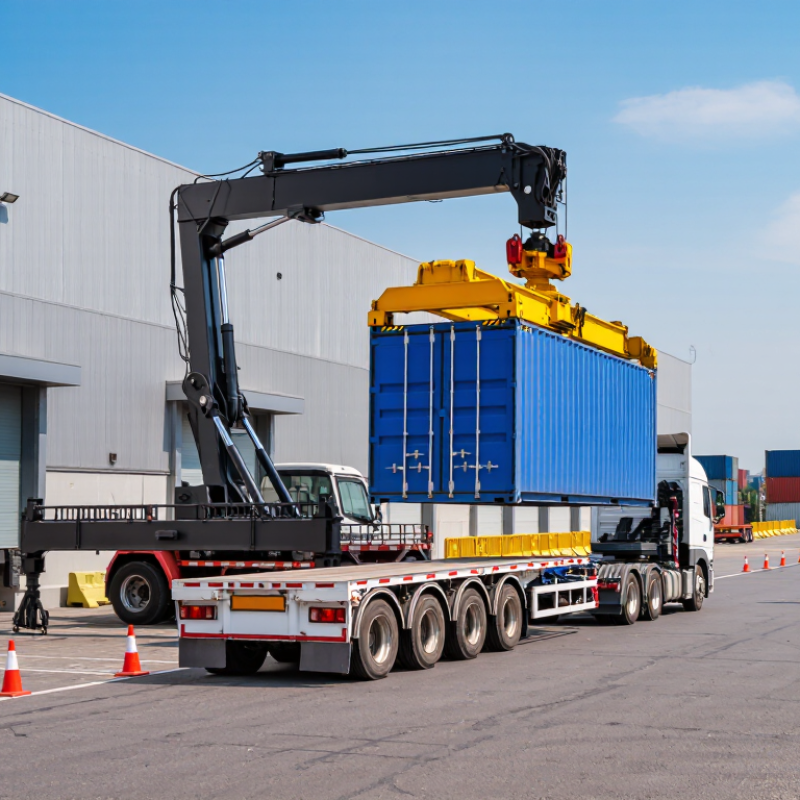
| Container or skip handling | Container hook, lifting frame, chains, or purpose-built handling attachment. | Designed for repeated handling of standardised containers or open skips. | Confirm container dimensions, attachment compatibility, chassis torsion, stability, and locking arrangements. | Waste collection, site services, recycling, and modular equipment transport. |
Selection note: The capacity and reach figures shown are representative industry ranges for comparison only. Actual performance depends on the specific crane model, boom length, hydraulic pressure, vehicle chassis, load centre, outrigger position, ground conditions, and applicable safety regulations. Always use the approved load chart and installation calculations for the final specification.
How to Choose a Side Loader Crane in 2026?
Evaluate Lifting Capacity, Reach, Stability, and Operating Performance
Start with the load chart, not the headline capacity. A side loader rated at 20 tonnes may lift far less at maximum reach. At 10 metres, a 20-tonne load creates a theoretical 200 tonne-metres of overturning moment. Chassis flex, boom angle, attachment weight, and ground conditions reduce the usable figure. Check capacity at your real working radius. It is a common mistake.
Reach must match the worksite. Measure loading height, sideways clearance, and the distance between the crane and truck bed. A longer boom is not automatically better. Excessive extension can slow cycles and demand wider stabilizer deployment. ISO 4305:2014 provides stability and load-test guidance for mobile cranes, while EN 12999:2021 addresses loader-crane design and safety functions. Ask for test records, rated load charts, and overload protection settings.
Stability depends on more than outriggers. Uneven soil, partial deployment, wind, and shifting cargo can change the operating envelope quickly. The U.S. Bureau of Labor Statistics recorded 5,283 fatal occupational injuries in 2023, with transportation and material-moving work remaining high-risk. That figure is not side-loader specific, but it reinforces disciplined planning. During a site trial, observe sway, hydraulic response, control precision, and recovery after sudden load movement. Quiet operation helps. It does not prove safe performance. A crane that lifts smoothly but cannot maintain stable geometry at full reach deserves another review.
Choosing a side loader crane in 2026 requires more than checking lifting capacity. Safety features should match real work conditions, including narrow roads, uneven yards, and frequent vehicle movement. Look for rated capacity indicators, overload protection, emergency stops, boom interlocks, and clearly visible control labels. Remote controls should include a reliable stop function and feedback when communication fails. The ILO reported that nearly three million workers die annually from work-related accidents and diseases. That figure makes small safety omissions difficult to defend.
Compliance must fit the crane’s operating country. Check applicable requirements such as EN 12999 for loader cranes, ASME B30.22, or local occupational safety rules. Ask for test certificates, load charts, inspection records, and conformity documentation. ISO 12480-1 also emphasizes planned lifting operations, competent personnel, and controlled work zones. Paperwork alone is not enough.
Maintenance planning should specify hydraulic inspections, hose replacement intervals, structural checks, lubrication points, and software updates. A practical inspection can reveal cracked paint near a boom joint or slow hydraulic drift. Small clues matter. Request service response times, technician coverage, spare-parts availability, and digital maintenance records. The Global Fleet Management Report 2024 found that maintenance remains a major operational cost for commercial fleets, yet delayed repairs often create greater downtime. I would still challenge one assumption: the cheapest crane may not be the most economical. A weak service network can turn a minor sensor fault into an idle truck for days.
How to Choose a Side Loader Crane in 2026?
Calculate Total Ownership Costs and Select the Best 2026 Model
Choosing a side loader crane starts with more than its purchase price. Calculate acquisition, installation, transport, insurance, training, maintenance, energy, and resale value. Use real numbers. A crane costing less initially may consume more fuel and require frequent hydraulic repairs. Record expected lifting cycles, average load weight, daily operating hours, and annual working days. These figures reveal the equipment’s actual cost per lift.
Maintenance records from similar operations can improve your estimate. Ask for service intervals, replacement part prices, warranty coverage, and average repair time. Downtime matters. One missed delivery can cost more than a routine service visit. Include operator training and safety inspections in the budget. Small details matter. I once underestimated hose replacement costs because the crane worked near abrasive construction dust. That mistake changed my evaluation method.
For 2026 models, compare diesel, hybrid, and electric power systems against your work pattern. Electric units may reduce noise and energy costs in urban yards, but battery charging time and replacement costs need careful review. Diesel models may suit remote routes with limited charging access. Check lifting radius, deck space, stabilizer design, control precision, and payload limits. Request verified performance data, not just brochure figures. Review independent maintenance feedback and confirm required certifications in your operating region. The best model is the one that delivers reliable lifts at the lowest practical ownership cost, not the one with the most features.